
Civic Future are hosting a conversation with Harry Halem and Nikita Gryazin on the Ukraine War.
Register for tickets here.
When Russian forces crossed the border on 24 February 2022, few in the West expected Ukraine to hold out for long. Predictions were made that Ukraine would fall within days, with US Chairman of the Joint Chiefs of Staff Gen. Mark Milley saying Kyiv could fall within 72 hours under a full-scale Russian invasion took place.
Yet over the last four and a half years, the war has reshaped Europe more than any event since the end of the Cold War. Finland and Sweden have abandoned decades of neutrality to join NATO, and European governments have committed to large rises in defence spending. The war has also produced enormous amounts of new technology, and reimagined how warfare is conducted across the world.
The continent has also largely ended its reliance on Russian energy. In the UK, this caused dramatic price shocks in electricity and ensuing high inflation, with the effects of the war still evident in household bills.
So why has the war lasted so long? The front has settled into a grinding war of drones, artillery and long-range strikes, where defence generally holds the advantage. The human cost is huge, yet diplomacy has produced repeated rounds of talks but no settlement.
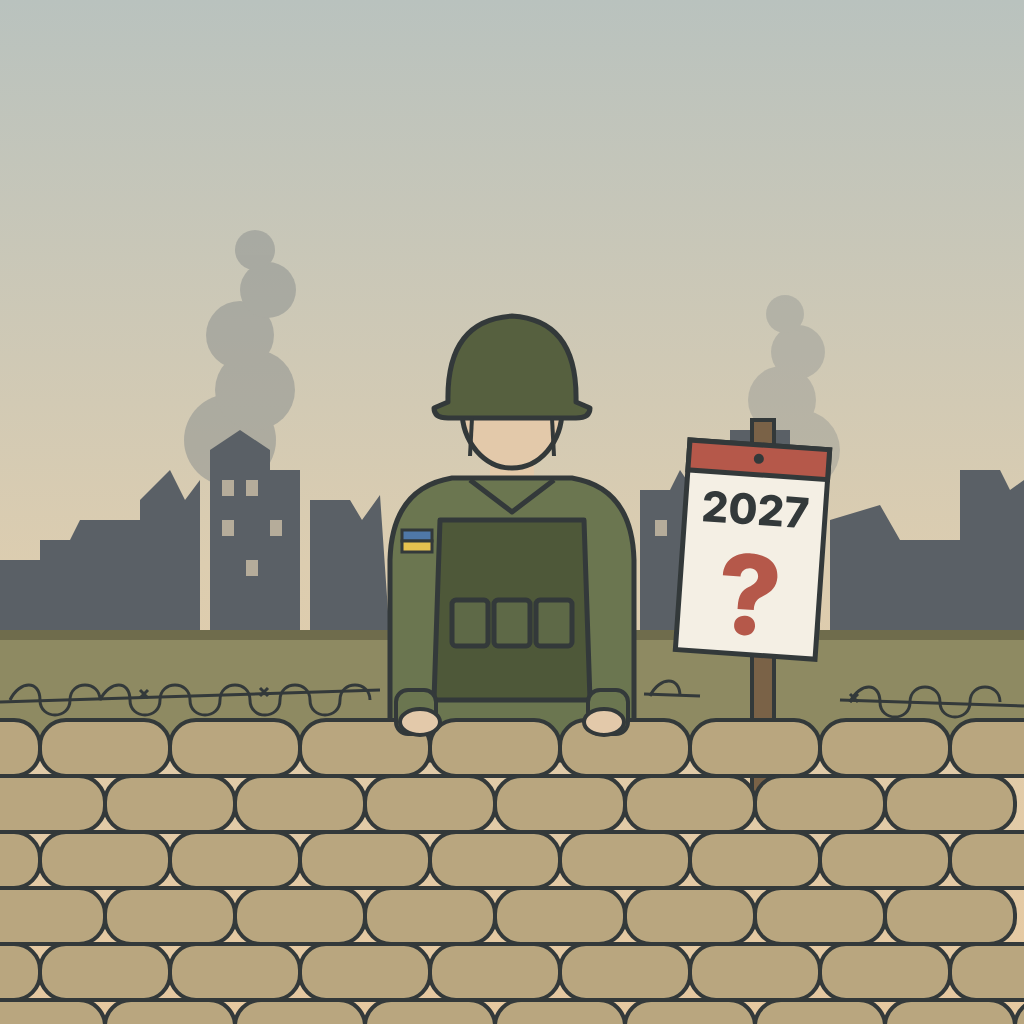
As international support for Ukraine shifts, many are predicting that the war could finally end in 2027. Is that correct, or will it keep grinding on even longer?
Please arrive at 6:30pm for a 6:45pm start.
Speakers:
Harry Halem is a Senior Fellow at Yorktown Institute, Military Advisor for Greenmantle, and the author of two books on military issues. He has published in the Wall Street Journal, National Review, the Spectator, and the Atlantic. He is a doctoral candidate at the LSE working on military intelligence issues. Originally from the US, Harry holds an MA in Philosophy and International Relations from the University of St Andrews and an MSc in Political Theory from LSE.
Nikita Gryazin is a Policy Fellow at European Leadership Network, within the Nuclear Weapons and New Technologies programme. His recent research examines European defence, transatlantic cooperation, and how technological and environmental change is reshaping security risks in Europe. Originally from Russia, he has an MPhil in International Relations from the University of Oxford, and BA and MA degrees in International Relations from HSE University in Moscow.